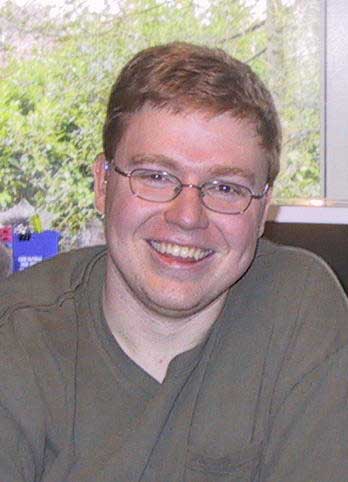
Seminar: Travis Holman (Georgetown University)
UWinChemBiochem Seminar Series - Fall 2018
Travis Holman
Department of Chemistry
Georgetown University
Title: “0D Porous Molecular Solids”
Web: https://www.holmanchemistry.net/
Friday, Sep. 21, 2018 @ 3:00 p.m.
Room #186 Essex Hall
**Everyone Welcome**
Showing posts with label seminar. Show all posts
Saturday, September 15, 2018
Seminar: Jaclyn Brusso (University of Ottawa) - Tues, Sep. 18, 2018 @ 3:00 p.m.
Seminar: Jaclyn Brusso (University of Ottawa)
UWinChemBiochem Seminar Series - Fall 2018
Jaclyn Brusso
Department of Chemistry
University of Ottawa
Title: “Exploring Polynuclear Complexes Through Ligand Design”
Web: https://science.uottawa.ca/chemistry/people/brusso-jaclyn
Tues, Sep. 18, 2018 @ 3:00 p.m.
Room #186 Essex Hall
**Everyone Welcome**
UWinChemBiochem Seminar Series - Fall 2018
Jaclyn Brusso
Department of Chemistry
University of Ottawa
Title: “Exploring Polynuclear Complexes Through Ligand Design”
Web: https://science.uottawa.ca/chemistry/people/brusso-jaclyn
Tues, Sep. 18, 2018 @ 3:00 p.m.
Room #186 Essex Hall
**Everyone Welcome**
Wednesday, September 12, 2018
Seminar - Jennifer van Wijngaarden (University of Manitoba) - Friday, Sep. 14, 2018 @ 3:00 p.m.
Seminar: Jennifer van Wijngaarden (University of Manitoba)
UWinChemBiochem Seminar Series - Fall 2018
Jennifer van Wijngaarden
Department of Chemistry
University of Manitoba
Title: “Resolving molecular mysteries: High resolution spectroscopy in the microwave and far infrared regions”
Web: https://home.cc.umanitoba.ca/~vanwijng/
Friday, Sep. 14, 2018 @ 3:00 p.m.
Room #186 Essex Hall
**Everyone Welcome**
UWinChemBiochem Seminar Series - Fall 2018
Jennifer van Wijngaarden
Department of Chemistry
University of Manitoba
Title: “Resolving molecular mysteries: High resolution spectroscopy in the microwave and far infrared regions”
Web: https://home.cc.umanitoba.ca/~vanwijng/
Friday, Sep. 14, 2018 @ 3:00 p.m.
Room #186 Essex Hall
**Everyone Welcome**
Friday, August 31, 2018
Seminar: Christer B. Aakeröy (Kansas State University) - Friday, Sep. 7, 2018 @ 3:00 p.m.
Seminar: Christer B. Aakeröy (Kansas State University)
UWinChemBiochem Seminar Series - Fall 2018
Christer B. Aakeröy - Friday, Sep. 7, 2018 @ 3:00 p.m.
Department of Chemistry
Kansas State University
Title: “From Molecular Dating to Functional Materials”
Web: https://www.k-state.edu/chem/people/grad-faculty/aakeroy/
Friday, Sep. 7, 2018 @ 3:00 p.m.
Room #186 Essex Hall
**Everyone Welcome**
UWinChemBiochem Seminar Series - Fall 2018
Christer B. Aakeröy - Friday, Sep. 7, 2018 @ 3:00 p.m.
Department of Chemistry
Kansas State University
Title: “From Molecular Dating to Functional Materials”
Web: https://www.k-state.edu/chem/people/grad-faculty/aakeroy/
Friday, Sep. 7, 2018 @ 3:00 p.m.
Room #186 Essex Hall
**Everyone Welcome**
Abstract
When molecules transition from solution into the condensed phase, their behavior and properties are to a large extent governed by intermolecular interactions. Despite the fact that such chemical bonds are relatively weak and reversible they are critically important to solubility, thermal and mechanical stability, optical properties, and many other key performance parameters of modern materials. Consequently, if we want to acquire the ability to design and construct new materials through a bottom-up approach that is both robust and versatile, we need a better understanding of the structural consequences, and balance between, intermolecular forces. In addition, we also need to establish more reliable and tangible connections between molecular structure and materials properties. In this presentation we will examine how several fundamental physical properties of a substance can be modified and ‘dialed-in’ through the use of co-crystallization technologies that are firmly anchored in a fundamental understanding of intermolecular forces. Applications relevant to pharmaceutics, agrochemicals, and explosives will be presented.
Saturday, July 14, 2018
Seminar: Jason Dutton (La Trobe University, Melbourne, Australia) - Tuesday, Jul. 17, 2018 @ 2:00 p.m.
Seminar: Jason Dutton (La Trobe University, Melbourne, Australia)
UWinChemBiochem Seminar Series - Winter 2018
Jason Dutton
Department of Chemistry & Physics
La Trobe University, Melbourne, Australia
Title: “Using Hypervalent Iodine to Unlock New Transition Metal and Main Group Chemistry”
Web: https://www.latrobe.edu.au/chemistry-and-physics/research/dutton
Tuesday, Jul. 17, 2018 @ 2:00 p.m.
Room #109 Essex Hall
**Everyone Welcome**
**Note the location and time**
Abstract:
The use of hypervalent I(III) reagents for the oxidation of late transition metals is a topic of major interest. In particular the groups of Sanford and Ritter have used I(III) compounds such as PhICl2 and PhI(OAc)2 to access Pd(IV) complexes, which have been used mainly in stoichiometric and catalytic C-H activations. The Dutton group has been studying the use of dicationic I(III) complexes [PhI(pyridine)]2+ as oxidants for late metals for chemistry involving Pd(IV), Pt(IV) and Au(III). Most significantly we have used this method to synthesize homoleptic Au(III) trications, which represent a new family of gold compounds. These Au(III) trications can be used to access unique reactivity between gold and water, as well as extremely rare examples of Au(III)-F complexes, generated using simple fluoride sources such as KF.
Jason Dutton
Department of Chemistry & Physics
La Trobe University, Melbourne, Australia
Title: “Using Hypervalent Iodine to Unlock New Transition Metal and Main Group Chemistry”
Web: https://www.latrobe.edu.au/chemistry-and-physics/research/dutton
Tuesday, Jul. 17, 2018 @ 2:00 p.m.
Room #109 Essex Hall
**Everyone Welcome**
**Note the location and time**
Abstract:
The use of hypervalent I(III) reagents for the oxidation of late transition metals is a topic of major interest. In particular the groups of Sanford and Ritter have used I(III) compounds such as PhICl2 and PhI(OAc)2 to access Pd(IV) complexes, which have been used mainly in stoichiometric and catalytic C-H activations. The Dutton group has been studying the use of dicationic I(III) complexes [PhI(pyridine)]2+ as oxidants for late metals for chemistry involving Pd(IV), Pt(IV) and Au(III). Most significantly we have used this method to synthesize homoleptic Au(III) trications, which represent a new family of gold compounds. These Au(III) trications can be used to access unique reactivity between gold and water, as well as extremely rare examples of Au(III)-F complexes, generated using simple fluoride sources such as KF.
Seminar: Keiji Hirose (Osaka University) - Monday, July 16, 2018 @ 2:00 p.m.
Seminar: Keiji Hirose (Osaka University)
UWinChemBiochem Seminar Series - Winter 2018
Name
Department of Materials Engineering Science
Osaka University
Title: “Elucidation of Molecular Design Guide for Rotaxane Type Molecular Machines under Consideration of Shuttling Dynamics”
Web: http://www.chem.es.osaka-u.ac.jp/supra/en/
Monday, July 16, 2018 @ 2:00 p.m.
Room #109 Essex Hall
**Note location and time***
**Everyone Welcome**
UWinChemBiochem Seminar Series - Winter 2018
Name
Department of Materials Engineering Science
Osaka University
Title: “Elucidation of Molecular Design Guide for Rotaxane Type Molecular Machines under Consideration of Shuttling Dynamics”
Web: http://www.chem.es.osaka-u.ac.jp/supra/en/
Monday, July 16, 2018 @ 2:00 p.m.
Room #109 Essex Hall
**Note location and time***
**Everyone Welcome**
Tuesday, July 3, 2018
Seminar: Norbert Kučerka (Joint Institute for Nuclear Research, Frank Laboratory of Neutron Physics, Dubna, Russia) - Friday, July. 6, 2018 @ 2:00 p.m.
Seminar: Norbert Kučerka (Joint Institute for Nuclear Research, Frank Laboratory of Neutron Physics, Dubna, Russia)
UWinChemBiochem Seminar Series - Spring/Summer 2018
Norbert Kučerka
Joint Institute for Nuclear Research, Frank Laboratory of Neutron Physics, Dubna, Russia
Title: “Condensed Matter Research at Frank Laboratory of Neutron Physics”
Web: http://www.norbbi.com/
Friday, July. 6, 2018 @ 2:00 p.m.
Room #186 Essex Hall
**Everyone Welcome - Note the 2 p.m. start time**
UWinChemBiochem Seminar Series - Spring/Summer 2018
Norbert Kučerka
Joint Institute for Nuclear Research, Frank Laboratory of Neutron Physics, Dubna, Russia
Title: “Condensed Matter Research at Frank Laboratory of Neutron Physics”
Web: http://www.norbbi.com/
Friday, July. 6, 2018 @ 2:00 p.m.
Room #186 Essex Hall
**Everyone Welcome - Note the 2 p.m. start time**
Labels:
Drew Marquardt,
neutron physics,
neutrons,
Norbert Kučerka,
russia,
seminar
Wednesday, May 16, 2018
Seminar - Ted Betley (Harvard University) - Thursday, May. 17, 2018 @ 3:00 p.m.
Seminar: Ted Betley (Harvard University)
UWinChemBiochem Seminar Series - Spring/Summer 2018
Ted Betley
Department of Chemistry and Chemical Biiology
Harvard University
Title: “Radical Frontiers in Catalysis”
Web: http://betleylab.chemistry.harvard.edu/
Thursday, May. 17, 2018 @ 3:00 p.m.
Room #186 Essex Hall
**Everyone Welcome**
UWinChemBiochem Seminar Series - Spring/Summer 2018
Ted Betley
Department of Chemistry and Chemical Biiology
Harvard University
Title: “Radical Frontiers in Catalysis”
Web: http://betleylab.chemistry.harvard.edu/
Thursday, May. 17, 2018 @ 3:00 p.m.
Room #186 Essex Hall
**Everyone Welcome**
Monday, March 12, 2018
Seminar: Ruma Banerjee (University of Michigan) - Friday, Mar. 16, 2018 @ 3:00 p.m.
Seminar: Ruma Banerjee (University of Michigan)
UWinChemBiochem Seminar Series - Winter 2018
Ruma Banerjee
University of Michigan Medical School
University of Michigan
Title: “Chemical Biology of H2S Signaling”
Web: https://medicine.umich.edu/dept/biochem/ruma-banerjee-phd
Friday, Mar. 16, 2018 @ 3:00 p.m.
Room #186 Essex Hall
**Everyone Welcome**
UWinChemBiochem Seminar Series - Winter 2018
Ruma Banerjee
University of Michigan Medical School
University of Michigan
Title: “Chemical Biology of H2S Signaling”
Web: https://medicine.umich.edu/dept/biochem/ruma-banerjee-phd
Friday, Mar. 16, 2018 @ 3:00 p.m.
Room #186 Essex Hall
**Everyone Welcome**
Wednesday, March 7, 2018
Jennifer Stockdill (Wayne State University) - Friday, Mar. 9, 2018 @ 3:00 p.m.
Seminar: Jennifer Stockdill (Wayne State University)
UWinChemBiochem Seminar Series - Winter 2018
Jennifer Stockdill
Department of Chemistry
Wayne State University
Title: “Strategies and methods for the synthesis of neuroactive disulfide-linked peptides”
Web: http://stockdillgroup.info/app/about-jenn/
Friday, Mar. 9, 2018 @ 3:00 p.m.
Room #186 Essex Hall
**Everyone Welcome**
Abstract:
Research in the Stockdill group is focused on the design of elegant and efficient strategies for the synthesis of neuroactive molecules ranging from complex alkaloids to disulfide-linked mini-proteins and for the detection of neurotransmitters. In the course of these efforts, we explore chemical reactivity and develop new reaction methods. This seminar will highlight our recent progress toward the synthesis of multi-disulfide containing conotoxins as well as the development new synthetic methods for peptide synthesis that have resulted from these synthetic studies.
For biographical info, see:
http://stockdillgroup.info/app/about-jenn/
UWinChemBiochem Seminar Series - Winter 2018
Jennifer Stockdill
Department of Chemistry
Wayne State University
Title: “Strategies and methods for the synthesis of neuroactive disulfide-linked peptides”
Web: http://stockdillgroup.info/app/about-jenn/
Friday, Mar. 9, 2018 @ 3:00 p.m.
Room #186 Essex Hall
**Everyone Welcome**
Abstract:
Research in the Stockdill group is focused on the design of elegant and efficient strategies for the synthesis of neuroactive molecules ranging from complex alkaloids to disulfide-linked mini-proteins and for the detection of neurotransmitters. In the course of these efforts, we explore chemical reactivity and develop new reaction methods. This seminar will highlight our recent progress toward the synthesis of multi-disulfide containing conotoxins as well as the development new synthetic methods for peptide synthesis that have resulted from these synthetic studies.
For biographical info, see:
http://stockdillgroup.info/app/about-jenn/
Wednesday, January 17, 2018
Seminar: Caleb Martin (Baylor University) - Friday, Jan. 19, 2018 @ 3:00 p.m.
Seminar: Caleb Martin (Baylor University)
UWinChemBiochem Seminar Series - Winter 2018
Caleb Martin
Department of Chemistry and Biochemistry
Baylor University, Waco, TX
Title: “Exploiting the Diverse Chemistry of Boroles to Access Unsaturated Boracycles”
Web: http://sites.baylor.edu/caleb_d_martin/
Friday, Jan. 19, 2018 @ 3:00 p.m.
Room #186 Essex Hall
**Everyone Welcome**
UWinChemBiochem Seminar Series - Winter 2018
Caleb Martin
Department of Chemistry and Biochemistry
Baylor University, Waco, TX
Title: “Exploiting the Diverse Chemistry of Boroles to Access Unsaturated Boracycles”
Web: http://sites.baylor.edu/caleb_d_martin/
Friday, Jan. 19, 2018 @ 3:00 p.m.
Room #186 Essex Hall
**Everyone Welcome**
Friday, January 12, 2018
Seminar: Jeff Reimer (University of California at Berkeley) - Tuesday, Jan. 16, 2018 @ 3:00 p.m.
Seminar: Jeff Reimer (University of California at Berkeley)
UWinChemBiochem Seminar Series - Winter 2018
Jeff Reimer
Department of Chemistry
University of California at Berkeley
Title: “Why, and How, I would like to Decarbonize our Air”
Web: https://chemistry.berkeley.edu/faculty/cbe/reimer
Tuesday, Jan. 16, 2018 @ 3:00 p.m.
Room #109 Essex Hall
**Everyone Welcome**
**Note the special room***
UWinChemBiochem Seminar Series - Winter 2018
Jeff Reimer
Department of Chemistry
University of California at Berkeley
Title: “Why, and How, I would like to Decarbonize our Air”
Web: https://chemistry.berkeley.edu/faculty/cbe/reimer
Tuesday, Jan. 16, 2018 @ 3:00 p.m.
Room #109 Essex Hall
**Everyone Welcome**
**Note the special room***
Labels:
Berkeley,
decarbonization,
Jeff Reimer,
Rob Schurko,
seminar,
solid-state NMR
Sunday, January 7, 2018
Seminar: Andre Simpson (Department of Chemistry, University of Toronto, Canada) - Friday, Jan. 12, 2018 @ 3:00 p.m.
Seminar: Andre Simpson (Department of Chemistry, University of Toronto, Canada)
UWinChemBiochem Seminar Series - Winter 2018
André J. Simpson
Friday, Jan. 12, 2018 @ 3:00 p.m.
**Everyone Welcome**
Department of Chemistry
University of Toronto
Title: “From Structure to Interactions to In vivo NMR: The vast potential of NMR Spectroscopy in Environmental Research”
Web: http://www.utsc.utoronto.ca/~asimpson/
Room #186 Essex Hall
Abstract:
UWinChemBiochem Seminar Series - Winter 2018
André J. Simpson
Friday, Jan. 12, 2018 @ 3:00 p.m.
**Everyone Welcome**
Department of Chemistry
University of Toronto
Title: “From Structure to Interactions to In vivo NMR: The vast potential of NMR Spectroscopy in Environmental Research”
Web: http://www.utsc.utoronto.ca/~asimpson/
Room #186 Essex Hall
Abstract:
NMR spectroscopy is arguably the most powerful tool for elucidating
structures and probing molecular interactions. Practically all environmental
research, at least to some extent, involves working with ultra-complex natural mixtures
that are ubiquitous in soil, water, and air. NMR can provide information not
only as to the basic chemical structures present in a mixture, but can
potentially provide information as to the self-associations of molecules
(aggregation and flocculation processes), their mechanistic interactions with
xenobiotics (transport of contaminants) and provide the direct connection
between molecular scale processes (environments of individual nuclei) and
macroscopic scale (visual), in the form NMR imaging.
This presentation will take the audience through an evolution of my
career from molecular-structure at one extreme to the impact of chemicals in
living systems at the other.
Structure: Understanding the structure of soils, air particles, and dissolved
organic is a critical precursor to understanding how these materials function. This
information is desperately needed to develop the most efficient soil
remediation and agricultural practices as-well as better predict carbon
sequestration and climate change.
Interactions: With a better understanding as to the structural components and NMR
assignments for key environmental matrices it is then possible to determine,
how, where, and why contaminants get sequestered and are challenging to
remediate. A range of novel NMR experiments will be introduced along with a new
technology termed comprehensive multi-phase NMR. Comprehensive Multiphase (CMP)
NMR, was co-developed between my group and Bruker Biospin. The approach
combines all the electronics from solution-state, semi-solid and solid-state
NMR into a single NMR probe. The resulting technology permits an uncompromised
analysis of liquid, semi-solid and solid components within unaltered samples in
their natural swollen state. As well as unravelling the binding orientation,
and receptors for contaminants/drugs CMP-NMR is also capable of monitoring the
kinetic transfer between and across interfaces providing an unprecedented
window into otherwise inaccessible molecular information.
Impact: With an understanding as to “what soil is?” and “which chemical components bind contaminants?" the key questions become “what does it all mean?” and “how are living systems impacted?”. For example, if a herbicide is bound tightly to the protein fraction of soil is it still bioavailable? Would this still hold true with climate change or change in land use? An even more challenging but important question is “out of the 100’s or 1000’s chemicals we are exposed to everyday which ones truly impacts our health?” Indeed similar questions are asked everyday by policy makers. NMR has great potential to address such challenges when employed as the “molecular interpreter” of living systems under environmental stress. In this final section in-vivo NMR is introduced on small invertebrates. Static studies (i.e. using a flow system and solution-state probes) provide a low stress environment to study metabolic flux in response to stressors. Conversely, CMP-NMR, can potentially be used to study and differentiate different phases (liquids (metabolites), gels (proteins, membranes), solids (shell, bone)) in-vivo. A wide range of novel experiments will be introduced that greatly improve the depth and breadth of information that can be obtained from NMR of living systems. Combined the approaches hold the potential to identify which are the most potent environmental stressors in complex natural samples, explain their toxic-mode-of-action and even act as early warning system to identify environmental stress, prior to disease, or ecosystem shifts.
Wednesday, January 3, 2018
Seminar: Amy Szuchmacher Blum (McGill University) - Friday, Jan. 5, 2018 @ 3:00 p.m.
Seminar: Amy Szuchmacher Blum (McGill University)
UWinChemBiochem Seminar Series - Winter 2018
Amy Szuchmacher Blum
Department of Chemistry
McGill University
Title: “Making viruses work for us: self-assembled nanostructured materials”
Web: http://www.mcgill.ca/chemistry/faculty/amy-blum
Friday, Jan. 5, 2018 @ 3:00 p.m.
Room #186 Essex Hall
**Everyone Welcome**
UWinChemBiochem Seminar Series - Winter 2018
Amy Szuchmacher Blum
Department of Chemistry
McGill University
Title: “Making viruses work for us: self-assembled nanostructured materials”
Web: http://www.mcgill.ca/chemistry/faculty/amy-blum
Friday, Jan. 5, 2018 @ 3:00 p.m.
Room #186 Essex Hall
**Everyone Welcome**
Tuesday, December 12, 2017
Paul Zelisko (Brock University) - Friday, Nov. 17, 2017 @ 3:00 p.m.
Seminar: Paul Zelisko (Brock University)
UWinChemBiochem Seminar Series - Fall 2017
Paul Zelisko
Department of Chemistry
Silicon and Silicone Chemistry and Centre for Biotechnology
Brock University
Title: “Chemoenzymatic Routes to Unique Siloxane Materials”
Web: https://brocku.ca/node/9904
Friday, Dec. 15, 2017 @ 3:00 p.m.
Room #186 Essex Hall
**Everyone Welcome**
UWinChemBiochem Seminar Series - Fall 2017
Paul Zelisko
Department of Chemistry
Silicon and Silicone Chemistry and Centre for Biotechnology
Brock University
Title: “Chemoenzymatic Routes to Unique Siloxane Materials”
Web: https://brocku.ca/node/9904
Friday, Dec. 15, 2017 @ 3:00 p.m.
Room #186 Essex Hall
**Everyone Welcome**
Labels:
Brock University,
Paul Zelisko,
seminar,
siloxanes
Tuesday, December 5, 2017
Seminar: Prof. Eric Munson, University of Kentucky - Monday, December 11, 2017 @ 3:00 p.m.
Seminar: Prof. Eric Munson, University of Kentucky
UWinChemBiochem Seminar Series - Fall 2017
Prof. Eric Munson
Department of Pharmaceutical Sciences
University of Kentucky
Title: “Solid-State NMR Studies of Crystalline and Amorphous Organic Solids: Applications to Pharmaceuticals”
Web: http://pharmacy.uky.edu/faculty/emu222/Eric-Munson
Monday, December 11, 2017 @ 3:00 p.m.
Room #186 Essex Hall
**Everyone Welcome**
UWinChemBiochem Seminar Series - Fall 2017
Prof. Eric Munson
Department of Pharmaceutical Sciences
University of Kentucky
Title: “Solid-State NMR Studies of Crystalline and Amorphous Organic Solids: Applications to Pharmaceuticals”
Web: http://pharmacy.uky.edu/faculty/emu222/Eric-Munson
Monday, December 11, 2017 @ 3:00 p.m.
Room #186 Essex Hall
**Everyone Welcome**
Seminar: Prof. John Protasiewicz, Case Western Reserve University - Friday, Dec. 8, 2017 @ 3:00 p.m.
Seminar: Prof. John Protasiewicz, Case Western Reserve University
UWinChemBiochem Seminar Series - Fall 2017
Prof. John Protasiewicz
Department of Chemistry
Case Western Reserve University
Title: Phosphorus as an element for hybrid inorganic-organic materials having interesting optoelectronic properties
Web: http://chemistry.case.edu/faculty/john-protasiewicz/
Friday, Dec. 8, 2017 @ 3:00 p.m.
Room #186 Essex Hall
**Everyone Welcome**
UWinChemBiochem Seminar Series - Fall 2017
Prof. John Protasiewicz
Department of Chemistry
Case Western Reserve University
Title: Phosphorus as an element for hybrid inorganic-organic materials having interesting optoelectronic properties
Web: http://chemistry.case.edu/faculty/john-protasiewicz/
Friday, Dec. 8, 2017 @ 3:00 p.m.
Room #186 Essex Hall
**Everyone Welcome**
Thursday, November 23, 2017
Safety Seminar - Chem & Biochem - Fri. Nov. 24, 2017 @ 3 p.m. in 206 Toldo
Safety Seminar
"It doesn’t happen by accident"
________________________________________________________________________________- All undergraduate students working in the labs
- All graduate students
- Post docs
- Visiting Students
- Faculty & Staff
**This is a mandatory seminar and all students must attend**
Friday, November 24, 2017
3:00 p.m.
Room #206 Toldo Building
**Everyone Welcome**
Labels:
departmental safety committee,
safety,
seminar
Tuesday, November 21, 2017
Seminar: Dr. Kari Rissanen (University of Jyväskylä, Finland) - Thurs. Nov. 23 @ 3:00 pm
Seminar: Dr. Kari Rissanen (University of Jyväskylä, Finland)
UWinChemBiochem Seminar Series - Fall 2017
Dr. Kari Rissanen
Department of Chemistry, University of Jyväskylä, Survontie Finland
Title: "Haloniumsupramolecular Chemistry, New Molecular Capsules"
https://www.jyu.fi/kemia/tutkimus/orgaaninen/en/research/rissanen
Thursday, Nov. 23, 2017 @ 3:00 p.m.
Room #109 Essex Hall
**Everyone Welcome**
UWinChemBiochem Seminar Series - Fall 2017
Dr. Kari Rissanen
Department of Chemistry, University of Jyväskylä, Survontie Finland
Title: "Haloniumsupramolecular Chemistry, New Molecular Capsules"
https://www.jyu.fi/kemia/tutkimus/orgaaninen/en/research/rissanen
Thursday, Nov. 23, 2017 @ 3:00 p.m.
Room #109 Essex Hall
**Everyone Welcome**
Abstract:
In contemporary crystal engineering halogen bonding is booming due to its directionality, specificity and high strength allowing preparation of highly complex structures with a high degree of accuracy and precision.1-3 Surprisingly, yet being the most difficult to achieve, hollow molecular assemblies solely based on halogen bonding have only very recently been achieved. Our group4 and Francois Diederich5 (ETH, Zürich) both published, in 2015 and nearly simultaneously, the first molecular capsules solely based on halogen bonds. Even though halogen bonding is more directional than hydrogen bonding it is even more sensitive to the environment and has thus mostly been demonstrated in the solid-state. Studies on halogen bond donor cavitands6 and collaboration with Mate Erdelyi (University of Gothenburg, Sweden, at present Uppsala University) on halonium ion based halogen-bonded complexes7 based on [N···Ag+···N] to [N···I+···N] cation exchange reaction inspired us to exploit halonium ions as very robust halogen bond donors. The first supramolecular, halonium ion mediated, dimeric capsule8 is based on a resorcinarene-based, conformationally fixed cavitand that is functionalized with four adjacent meta-pyridyl units acting as the XB acceptors. Assembly of the two cavitands first with silver(I) cations followed by a subsequent reaction of the dimeric silver capsule with molecular iodine leads to [N···I+···N] halogen-bonded dimeric capsule through [N···Ag+···N] to [N···I+···N] cation exchange reaction.8 Most recently we have managed to create an extremely robust large, even hexameric, halogen-bonded molecular capsules with the help of [N•••I+•••N] halogen bonds.9-10
References
1. a) G. Cavallo, P. Metrangolo, R. Milani, T. Pilati, A. Priimagi, G. Resnati, G. Terraneo, Chem. Rev. 116 (2016),
2478.
2. G. R. Desiraju, P. S. Ho, L. Kloo, A. C. Legon, R. Marquardt, P. Metrangolo, P. A. Politzer, G. Resnati, K
Rissanen, Pure Appl. Chem. 85 (2013), 1711.
3. K. Rissanen, CrystEngComm. 10 (2008), 1107.
4. N. K. Beyeh, F. Pan, K. Rissanen, Angew. Chem., 54 (2015), 7303.
5. O. Dumele, N. Trapp, F. Diederich, Angew. Chem. Int. Ed. 54 (2015), 12339.
6. L. Turunen, N. K. Beyeh, F. Pan, A. Valkonen and K. Rissanen, Chem. Commun. 50 (2014), 15920.
7. a) M. Bedin, A. Karim, M. Reitti, A.-C. C. Carlsson, F. Topic, M. Cetina, F. Pan, V. Havel, F. Al-Ameri, V.
Sindelar, K. Rissanen, J. Gräfenstein and M. Erdélyi, Chem. Sci . 6 (2015), 3746; b) A.-C. C. Carlsson, K.
Mehmeti, M. Uhrbom, A. Karim, M. Bedin, R. Puttreddy, R. Kleinmaier, A. A. Neverov, B. Nekouesihahraki, J.
Gräfenstein, K. Rissanen and M. Erdélyi, J. Am. Chem. Soc. 138 (2016), 9853; c) K. Rissanen and M. Haukka, Top.
Curr. Chem. 359 (2015), 77., d) L. Koskinen, P. Hirva, E. Kalenius, S. Jääskeläinen, K. Rissanen and M. Haukka,
CrystEngComm 17 (2015), 1231.
8. L. Turunen, U. Warzok, R. Puttreddy, N. K. Beyeh, C. A. Schalley and K. Rissanen, Angew. Chem. 55 (2016), 14239.
9. L. Turunen, A. Peuronen, S. Forsblom, E. Kalenius, M. Lahtinen and K. Rissanen, Chem. Eur. J. 23 (2017), 11714.
10. L. Turunen, U. Warzok, C. A. Schalley and K. Rissanen, Chem (2017), in press. DOI: 10.1016/j.chempr.2017.08.010
Friday, November 17, 2017
Seminar: Prof. Robert Scott (University of Saskatchewan) - Friday, Nov. 17, 2017 @ 3:00 p.m. 186 Essex Hall
Seminar: Prof. Robert Scott (University of Saskatchewan)
UWinChemBiochem Seminar Series - Fall 2017
Dr. Robert Scott
Department of Chemistry
University of Saskatchewan
Title: “Shining Light on Cluster and Nanoparticle Catalysts”
http://www.usask.ca/chemistry/groups/scott/
Friday, Nov. 17, 2017 @ 3:00 p.m.
Room #186 Essex Hall
**Everyone Welcome**
UWinChemBiochem Seminar Series - Fall 2017
Dr. Robert Scott
Department of Chemistry
University of Saskatchewan
Title: “Shining Light on Cluster and Nanoparticle Catalysts”
http://www.usask.ca/chemistry/groups/scott/
Friday, Nov. 17, 2017 @ 3:00 p.m.
Room #186 Essex Hall
**Everyone Welcome**
Abstract:
In this seminar, I will discuss work in our group focusing on the development of cluster and nanoparticle catalysts which have high catalytic activity, excellent selectivity towards specific substrates, and excellent durability and recyclability. Our current work involves the synthesis and stabilization of clusters and nanoparticles in solution followed by activating them for catalysis. Several routes towards such goals will be discussed, including the activation of monolayer-protected Au clusters and structural control of bimetallic nanoparticles. Characterization tools which can assist in elucidating surface chemistry and/or cluster and nanoparticle sizes and structures will be detailed, including mass spectrometry, HRTEM, and in situ x-ray absorption spectroscopy at the Canadian Light Source.
Labels:
Robert Scott,
Saskatchewan,
seminar
Subscribe to:
Posts (Atom)