UWinChem

Showing posts with label Canada Research Chair. Show all posts

Tuesday, March 29, 2016

Loeb awarded Erskine Fellowship in New Zealand


Congratulations to Steve Loeb, Professor and Canada Research Chair in the Department of Chemistry and Biochemistry, who has been awarded a prestigious Erskine Fellowship from the University of Canterbury in Christchurch, New Zealand. The Erskine Fellowship program provides international visitors with the cost of transportation to New Zealand plus local accommodation and living expenses for the visiting fellow and their spouse. 
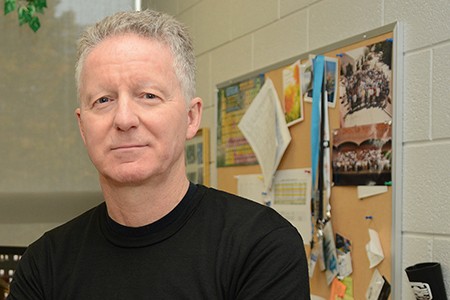

The Fellowship requires the visiting fellow to interact with the researchers in the department and give a short series of lectures in their area of expertise to senior undergraduate and graduates students - previous Fellows in Chemistry include 2005 Nobel Laureate Robert Grubbs of Caltech.  Loeb will be visiting New Zealand for six weeks in April and May. In addition to his interactions with University of Canterbury, he will also be giving research lectures at other New Zealand universities; University of Auckland, University of Otago and Massey University.

We wish Professor Loeb success in New Zealand, and safe travels!

For more information on Professor Loeb's research, click here!

Wednesday, August 1, 2012

Chemists break new ground in molecular machine research

Nick Vukotic, left, and Kristopher Harris are two of the team members who developed and tested University of Windsor Dynamic Material, UWDM-1.


A graduate student and his team of researchers have turned the chemistry world on its ear by becoming the first ever to prove that tiny interlocked molecules can function inside solid materials, laying the important groundwork for the future creation of molecular machines.
“Until now, this has only ever been done in solution,” explained Chemistry & Biochemistry PhD student Nick Vukotic, lead author on a front page article recently published in the June issue of the journal Nature Chemistry. “We’re the first ones to put this into a solid state material.”

schematic diagram of UWDM-1
This schematic shows how the various elements assemble themselves into mechanically interlocked molecules.
The material Vukotic is referring to is UWDM-1, or University of Windsor Dynamic Material, a powdery substance that the team made which contains rotaxane molecules and binuclear copper centers.  The rotaxane molecules, which resemble a wheel around the outside of an axle, were synthesised in their lab. The group found that heating of these rotaxane molecules with a copper source resulted in the formation of a crystalline material which contained structured arrangement of the rotaxane molecules, spaced out by the binuclear copper centers.

“Basically, they self-assemble in to this arrangement,” said Vukotic, who works under the tutelage of chemistry professor Steve Loeb. Other team members include professor Rob Schurko, and post-doctoral fellows Kristopher Harris and Kelong Zhu.

Heating the material causes the wheels to rapidly rotate around the axles, while cooling the material causes the wheels to stop, he said. The entire process can’t be viewed with a microscope, so the motion was confirmed in Dr. Schurko’s lab using a process called nuclear magnetic resonance spectroscopy.

“You can actually measure the motion and you can do it unambiguously by placing an isotopic tag on the ring,” explained Dr. Harris, who helped oversee that verification process.
Although the team admits their findings are still very much a proof of principle, they insist that molecules in solid materials can be manipulated to form switches and machines. This could be extremely significant and could find future applications in the fields of computer storage, data transfer or controlling the electronic properties of materials at the molecular level.

“Important metal organic frameworks like this are typically named after the university in which they were created,” Vukotic said of the material’s name. “It also emphasizes that this material is a prototype for other dynamic materials to come.”

Since the Nature Chemistry article appeared, a number of leading chemistry publications around the world have been reporting on the team’s findings, Dr. Loeb said.

“It’s a starting point,” said Loeb, who first imagined the concept about 10 years ago. “It’s a blueprint, but it’s the first demonstration of motion in a solid state. Normally when you make a new material you’re done. You can’t reorient molecules in a solid state.”

This story originally appeared on the Daily News, and is written by Stephen Fields
http://www.uwindsor.ca/dailynews/2012-06-15/chemists-break-new-ground-in-molecular-machine-research

Thursday, October 27, 2011

Ultra-fast magic-angle spinning NMR probe up and running

Prof. Rob Schurko's NMR group has recently taken delivery of an ultra-fast magic-angle spinning NMR probe, which will be used for acquiring high-resolution 1H NMR spectra of a variety of different materials, including solid pharmaceuticals. The probe was purchased for ca. $110,000 using funds obtained from an NSERC RTI (Research Tools and Instruments) Grant.

To read the Daily News story on this amazing probe, click here!

Friday, February 4, 2011

Windsor student discovers promising cancer treatment option

Congratulations to Carly Griffin: Carly defended her Ph.D. thesis successfully on Jan 6th 2011.

by Meghan Scanlan — The Lance (University of Windsor)

WINDSOR, Ont. (CUP) — After her father was diagnosed with colon cancer, Carly Griffin made it her life’s ambition to find a cure for cancer.

After the devastating loss of her father and several years of research, she may have reached her goal.

“Ultimately, that fuelled my decision to study biochemistry at the University of Windsor,” said Griffin.

In her third year at the University of Windsor, she actively pursued her goal of finding a cure by inquiring about a position in Siyaram Pandey’s research lab. It is in this lab that Griffin would work on the substance of her PhD, now proven to be a promising advance in cancer research.

The key to Griffin’s success is found in the rare Hawaiian spider lily plant. The plant and its cancer-killing compounds according to Griffin “have been studied by organic chemists for decades.”

Pandey became interested after attending a weekly seminar hosted by the chemistry department. Interested in testing the plant’s anti-cancer activity, Pandey handed the task off to two volunteer undergraduate students.

According to Griffin, two very exciting things happened for Pandey, his volunteers and for the world of cancer research.

The volunteer research students found that pancratistatin, a compound found in the Hawaiian spider lily plant, was very potent against cancer cells. They also found that there was currently no other research group actively studying pancratistatin.

In 2004, Griffin joined the research group and says she has “spent the last six years trying to figure out how pancratistatin works against cancer.”

To see the entire article, please check out the following link:

Professor Siyaram Pandey receives three year CIHR grant for $302,000

Congratulations to Professor Siyaram Pandey, who as received a research grant of $302,000 over three years (2011-2014) for a research project entitled "Investigation of mechanism of neuroprotection by a water-soluble CoQ10 in a paraquat induced model of Parkinson's disease," in collaboration with Dr. Jerome Cohen (Psychology). This project application was ranked in the top three in this grant review committee.

For more information on Dr. Pandey's research, please visit:

For more information on CIHR funding, please visit:

Wednesday, September 1, 2010

New CRC Chair - Professor Jeremy Rawson

The Department of Chemistry and Biochemistry welcomes its newest member - Jeremy Rawson - who takes the post of Canada Research Chair in Inorganic and Molecular Materials. Prof. Rawson comes to us from Cambridge University, where he was a Senior Lecturer. One of his inspirations for applying for this position at Windsor was Prof. Dennis Tuck, a senior inorganic chemist in our department who passed away in 2003. To read more about this, click here. Also, please visit Prof. Rawson's profile page.