Welcome event for new grad students - Thursday, September 13, 2018 at 12:00noon
On Thursday, September 13, 2018 at 12:00 noon, we will be having a department social and providing pizza, drinks and desserts for the entire department.
It will be an opportunity for everyone to meet the new graduate students and welcome them to the department.
Location: 273 Essex Hall - conference room.
Showing posts with label graduate students. Show all posts
Tuesday, September 11, 2018
Friday, May 11, 2018
NMR Workshop - May 23 and May 24
2 DAY Workshop: Introduction to Practical Aspects of Solution NMR for Chemists
Wednesday May 23 to Thursday Thursday 24 : 9 am to noon each day
This introductory workshop is geared toward undergraduate students, and new graduate students with limited NMR experience, but who are expected to make use of the NMR spectrometers as part of their research projects.
The workshop is meant as a supplement to the "one on one" training that new NMR users receive and will allow an opportunity to go into greater depth on many topics, therefore students who have recently started to use our NMR instruments are especially encouraged to attend. There will be an Advanced NMR Workshop offered later in the summer.
The schedule will consist of a lecture to start each day followed by hands-on learning sessions where participants will get the opportunity to collect and process NMR data.
The topics covered include:
Wednesday May 23 to Thursday Thursday 24 : 9 am to noon each day
This introductory workshop is geared toward undergraduate students, and new graduate students with limited NMR experience, but who are expected to make use of the NMR spectrometers as part of their research projects.
The workshop is meant as a supplement to the "one on one" training that new NMR users receive and will allow an opportunity to go into greater depth on many topics, therefore students who have recently started to use our NMR instruments are especially encouraged to attend. There will be an Advanced NMR Workshop offered later in the summer.
The schedule will consist of a lecture to start each day followed by hands-on learning sessions where participants will get the opportunity to collect and process NMR data.
The topics covered include:
- How an NMR spectrometer works
- NMR Magnet Safety
- Preparation of NMR Samples
- Set up of 1D 1H and 13C NMR Experiments
- Processing and Presentation of NMR Data
The workshop is free of charge to members of the Dept. of Chemistry and Biochemistry; however, enrollment is limited, so please register soon!
Please note that a separate Intro Workshop will be held for MMB students in July so MMB students should not register for this workshop.
For more information, contact:
Matthew Revington
NMR Facility Manager, RM 394-5 Essex Hall
Department of Chemistry and Biochemistry
University of Windsor
519-253-3000 Ext 3997
NMR Facility Manager, RM 394-5 Essex Hall
Department of Chemistry and Biochemistry
University of Windsor
519-253-3000 Ext 3997
Friday, May 19, 2017
2 Day Workshop: Introduction to Practical Aspects of Solution NMR for Chemists
Wednesday May 24 and Thursday May 25:
9:00 am to 12:00 pm each day
This introductory workshop is geared toward undergraduate students, and new graduate students with limited NMR experience, but who are expected to make use of the NMR spectrometers as part of their research projects.
The workshop is meant as a supplement to the "one on one" training that new NMR users receive and will allow an opportunity to go into greater depth on many topics, therefore students who have recently started to use our NMR instruments are especially encouraged to attend. There will be an Advanced NMR Workshop offered later in the summer.
The schedule will consist of a lecture to start each day followed by hands-on learning sessions where participants will get the opportunity to collect and process NMR data.
The topics covered include:
The workshop is free of charge to members of the Dept. of Chemistry and Biochemistry; however, enrolment is limited, so please register soon!
Please note that a separate Intro Workshop will be held for MMB students in July so MMB students should not register for this workshop.
To register click here
Wednesday May 24 and Thursday May 25:
9:00 am to 12:00 pm each day
This introductory workshop is geared toward undergraduate students, and new graduate students with limited NMR experience, but who are expected to make use of the NMR spectrometers as part of their research projects.
The workshop is meant as a supplement to the "one on one" training that new NMR users receive and will allow an opportunity to go into greater depth on many topics, therefore students who have recently started to use our NMR instruments are especially encouraged to attend. There will be an Advanced NMR Workshop offered later in the summer.
The schedule will consist of a lecture to start each day followed by hands-on learning sessions where participants will get the opportunity to collect and process NMR data.
The topics covered include:
- How an NMR spectrometer works
- NMR Magnet Safety
- Preparation of NMR Samples
- Set up of 1D 1H and 13C NMR Experiments
- Processing and Presentation of NMR Data
The workshop is free of charge to members of the Dept. of Chemistry and Biochemistry; however, enrolment is limited, so please register soon!
Please note that a separate Intro Workshop will be held for MMB students in July so MMB students should not register for this workshop.
To register click here
Friday, April 28, 2017
ChemProm2017 - Friday April 28, 2017
It's that time of year again... the biggest annual gala for the Department of Chemistry and Biochemistry....
The Chem Club Presents:
CHEM PROM 2017
Fri. April 28, 2017
Salon A @ Ciociaro Club
Doors open @ 6:00pm
Dinner @ 7:00pm
Tickets $40
See Cody Caba, Chris O'Keefe, or the Chemistry Main Office for tickets
Wednesday, March 29, 2017
C&B grad student wins the Three Minute Thesis Competition
A big congratulations to Travis DeWolfe, (M.Sc. student in the Gauld group) for winning the Three Minute Thesis competition today. Travis will be in the Finals at Waterloo University. Good luck Travis.
C&B grad students have won this event 3 out of the 5 years the 3MT competition has been in existence on the UWindsor campus.
Read a story about the 3MT competition here:
Thursday, September 15, 2016
Welcome Back Social by the Chem Club - Fri. Sep. 16 @ 7 p.m.
What: Chem Club Welcome Social
When: Friday, September 16th @7pm
Where: Barrel House (3199 Sandwich Street)
Hope to see everyone Friday night to welcome new faculty and students into the department, as well as welcome back all students after a great summer! This event is open to undergraduate research students working in labs as well.
Thank you!
What: Chem Club Welcome Social
When: Friday, September 16th @7pm
Where: Barrel House (3199 Sandwich Street)
Hope to see everyone Friday night to welcome new faculty and students into the department, as well as welcome back all students after a great summer! This event is open to undergraduate research students working in labs as well.
Thank you!
Monday, September 12, 2016
Departmental Social - Welcome to the new graduate students! Fri. Sept. 16, 2016
TO ALL FACULTY, STAFF AND GRADUATE STUDENTS
On Friday, September 16, 2016 at noon there will be an opportunity for everyone to meet all our new graduate students and socialize with pizza and drinks.
Everyone is welcome to attend.
Room #273 Essex Hall.
Marlene
Thursday, September 1, 2016
NSERC Scholarship Information Session - Sept. 12, 2016 at 9 a.m.
ATTENTION: 4TH YEAR UNDERGRADUATE STUDENTS, MASTER'S AND PHD STUDENTS
If
you are planning to apply for NSERC graduate scholarships/fellowships
for next year (2017), please plan to attend the following information
session:
Date: Monday, September 12, 2016
Time: 9:00 a.m.
Location: McPherson Lounge, Alumni Hall, 750 Sunset Avenue
This
session will be an overview of the various scholarships available,
including the Canada Graduate Scholarship (Master’s), Postgraduate
Scholarships, and Postdoctoral Fellowships
In
preparation for the session, please visit the NSERC website and view
the resources available on-line (tutorials, videos), as follows:
Natural Science and Engineering Research Council (NSERC):
(Canadian or Permanent Residents only)
Doctoral
http://www.nserc-crsng.gc.ca/ students-etudiants/pg-cs/ bellandpostgrad- belletsuperieures_eng.asp
NSERC Resource Videos:
http://www.nserc-crsng.gc.ca/ Students-Etudiants/Videos- Videos/Index_eng.asp
If you are unable to attend at this time, we will have the presentation materials available afterwards on our website (http://www.uwindsor.ca/grad).
Note that these scholarships are available only to Canadian citizens and Permanent Residents.
Wednesday, April 27, 2016
Final undergraduate research presentations - 59-410 - April 27-28, 2016
The final 59-410 undergraduate research presentations take place on April 27 and 28, 2016 in Room 186 Essex Hall.
Everyone is welcome to attend! Come support our students!
The final 59-410 undergraduate research presentations take place on April 27 and 28, 2016 in Room 186 Essex Hall.
Everyone is welcome to attend! Come support our students!
Sessional appointments are available for Fall 2016 to teach graduate courses for the MMB program
Employment Opportunities
SESSIONAL APPOINTMENT – Fall 2016
Master of Medical Biotechnology Program
Sessional appointments are available for Fall 2016 to teach graduate courses for the MMB program. For more information, click here!
http://www1.uwindsor.ca/chemistry/chemistry/employment-opportunities
SESSIONAL APPOINTMENT – Fall 2016
Master of Medical Biotechnology Program
Sessional appointments are available for Fall 2016 to teach graduate courses for the MMB program. For more information, click here!
http://www1.uwindsor.ca/chemistry/chemistry/employment-opportunities
Labels:
employment,
graduate courses,
graduate students,
job postings,
MMB
Wednesday, April 6, 2016
Registration and abstract submission for CEMWOQ-3: Opened April 6, 2016
Registration and abstract submission are now open for the 3rd Crystal Engineering and Emerging Materials Workshop of Ontario and Quebec (CEMWOQ-3), which will be held at the University of Windsor on the weekend of May 14 -15, 2016. The meeting will provide a forum for researchers with broad interests in the fields of Molecular and Molecule-based Materials, including:
* structure and dynamics in the solid state
* solid state (topochemical) reactions
* materials properties; conductivity, magnetism, multi-ferroics, optical properties.
* liquid crystals;
* metal organic frameworks;
* polymorphism and crystal engineering;
* synthetic methods; microwave, grinding and solvent-assisted grinding.
Registration and abstract submission opens:
Apr. 6, 2016
Abstract submission closes:
May 5, 2016
Registration closes:
May 10, 2016
Click here to visit our registration and abstract submission page:
http://cemwoq.cs.uwindsor.ca/Registration/index.html
For more information, please visit:
http://cemwoq.cs.uwindsor.ca/
http://www.thiazyl.com/CEMWOQ-3.html
Conference chairs:
Jeremy Rawson
Rob Schurko
Holger Eichhorn
* structure and dynamics in the solid state
* solid state (topochemical) reactions
* materials properties; conductivity, magnetism, multi-ferroics, optical properties.
* liquid crystals;
* metal organic frameworks;
* polymorphism and crystal engineering;
* synthetic methods; microwave, grinding and solvent-assisted grinding.
Registration and abstract submission opens:
Apr. 6, 2016
Abstract submission closes:
May 5, 2016
Registration closes:
May 10, 2016
Click here to visit our registration and abstract submission page:
http://cemwoq.cs.uwindsor.ca/Registration/index.html
For more information, please visit:
http://cemwoq.cs.uwindsor.ca/
http://www.thiazyl.com/CEMWOQ-3.html
Conference chairs:
Jeremy Rawson
Rob Schurko
Holger Eichhorn
Saturday, March 26, 2016
Trivia Night - Wed. Mar. 30, 2016
The Chem Club is hosting a Trivia Night on Wed. Mar. 30, 2016 at Mare Nostrum Restaurant on campus.
Doors open at 6 PM, and trivia starts at 7 PM.
Entry fee: $2 per person
Teams: 4-5 people
Team reservations can be made with:
chemclub@uwindsor.ca
or by talking to Mitch N., Chris O., or Cody C.
Doors open at 6 PM, and trivia starts at 7 PM.
Entry fee: $2 per person
Teams: 4-5 people
Team reservations can be made with:
chemclub@uwindsor.ca
or by talking to Mitch N., Chris O., or Cody C.
Wednesday, November 11, 2015
Tea with Lee at 3
Dr. Lee would like to host a "Tea with Lee at 3" on Thursday, November 19th in the Student Centre, Room #250 Essex Hall.
She will provide the tea and desserts.
Thank you Dr. Lee!
ALL GRADUATE STUDENTS, FACULTY, STAFF AND MMB STUDENTS are welcome!
REMINDER:
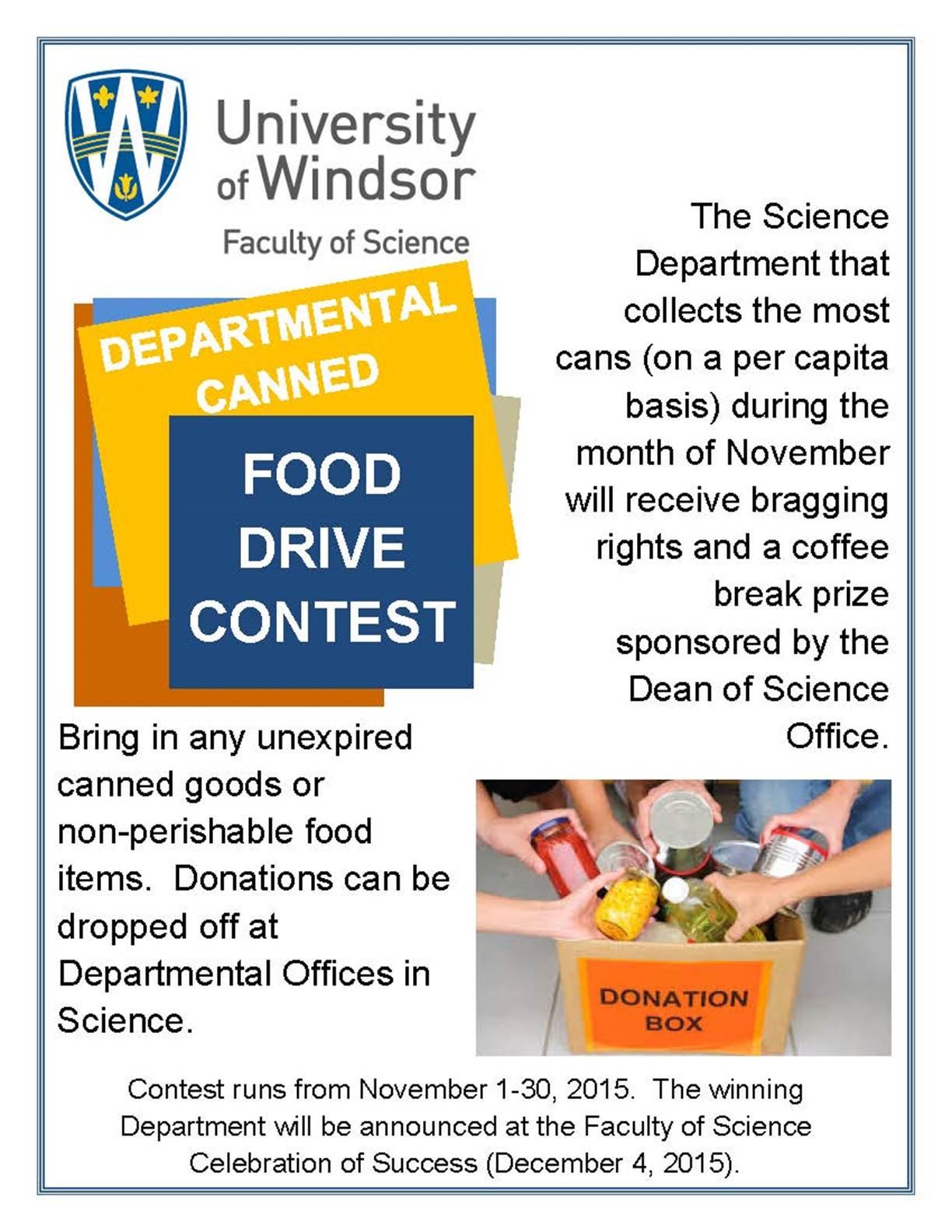
Food Drive Challenge
The Faculty of Science has challenged all Science departments to a Food Drive.
Since Chemistry & Biochemistry have always been up for a challenge, and determined to win, we are asking that (if you're able to), bring one or two canned goods to the "Tea with Lee" event.
Be sure you bring them to the Chemistry office, #273 Essex Hall. Do not put them in the big box in the hallway, as this belongs to the Faculty of Science department.
Suggested canned goods are: soup, vegetables, fruit, zoodles, pasta sauce, etc.
See attached flyer for further information. Hope to see everyone there.
Labels:
canned food drive,
faculty,
graduate students,
lana lee,
Lee,
MMB,
staff,
tea
Friday, October 30, 2015
Chemistry and Biochemistry Canned Food Drive
All Chemistry and Biochemistry Faculty, Staff, PDF, Grad and 410 Students:
Bring in your unexpired can goods or non perishable food items.
You are being challenged - lets set a record and beat the other departments in the Faculty of Science. If we win, we get to share a coffee break!
There is a box set up in the main office. Contest runs from Nov. 1-30, 2015
Details below.
Labels:
59-410,
canned food drive,
charity,
chemistry,
christmas,
faculty,
faculty of science,
graduate students,
outreach,
PDF,
xmas
Sunday, October 25, 2015
Corey Scipione wins poster prize at Canadian Lipoprotein Conference
Congratulations to Corey Scipione (Koschinsky group), who was awarded a $500 prize for best graduate student poster at the recent Canadian Lipoprotein Conference.
The presentation was entitled: "Lp(a)/apo(a) promotes pro-inflammatory responses in vascular cells: A role for the oxPL moiety on apo(a)."
Corey, along with other members of the Koschinsky lab (Dr. Rocco Romagnuolo, presented an oral presentation and Matthew Gemin, presented a poster presentation) presented their work at the 40th Annual Canadian Lipoprotein Conference in Toronto this past weekend.
The presentation was entitled: "Lp(a)/apo(a) promotes pro-inflammatory responses in vascular cells: A role for the oxPL moiety on apo(a)."
Corey, along with other members of the Koschinsky lab (Dr. Rocco Romagnuolo, presented an oral presentation and Matthew Gemin, presented a poster presentation) presented their work at the 40th Annual Canadian Lipoprotein Conference in Toronto this past weekend.
Windsor Research Spotlight - Stretching the Limit
NSERC Research Spotlight - Stretching the Limit
A research team at the University of Windsor has found that working with a problem, instead of against it, can result in incredible breakthroughs. Chemistry professor Tricia Carmichael and co-investigator Heather Filiatrault have successfully created stretchable electronics able to continue conducting electricity even after stretching to the point of cracking.
Stretchable light-emitting devices are the building blocks of foldable and expandable display screens and electronics-integrated clothing, as well as other soft devices designed to go inside a body, like a stretchable balloon catheter that can mend damaged areas of the heart.
“The dilemma with the design of these devices is that when we use electrically conductive materials, like aluminum or copper, these materials will crack when stretched even a minimal amount,” says Dr. Carmichael.
Stretchable electronics integrate a thin film of electrically conductive material with a film of rubber, but the conductive materials crack when they are stretched, which breaks the circuit and renders the device useless.
Carmichael and her lab team investigated the theory that when a rough surface is stretched it generates multiple micro-cracks, instead of a few large debilitating cracks. To manipulate the cracking, she simply added a layer of inexpensive white glue before the thin sheet of metal was attached.
“Instead of eliminating cracks, we encouraged a lot of cracking, like a spider web of cracks that don’t form a continuous pathway through the sheet,” says Carmichael. “The cracks purposefully interfere with each other, relieving the strain, so the current can flow along a jagged but continuous pathway.”
The glue layer is watered down to control the film thickness. It is spread over the rubber layer and creates the required roughness by forming blobs. Members of Carmichael’s lab built a strain sensor out of rubber, glue and gold and wrapped it around a thumb. The sensor successfully monitored when the digit was extended, and when it was not.
Carmichael says this is a low-cost, green solution, which uses simple components that could potentially scale up to larger surface devices.
“We made the system more defective in order to make it work better,” she says. “I love this concept of embracing the natural tendency of cracking, and then pushing it further.”
This research is published as the cover story in the September 30th edition of
ACS Applied Materials & Interfaces.
To see the original story on the NSERC web site, click here.
A research team at the University of Windsor has found that working with a problem, instead of against it, can result in incredible breakthroughs. Chemistry professor Tricia Carmichael and co-investigator Heather Filiatrault have successfully created stretchable electronics able to continue conducting electricity even after stretching to the point of cracking.
Stretchable light-emitting devices are the building blocks of foldable and expandable display screens and electronics-integrated clothing, as well as other soft devices designed to go inside a body, like a stretchable balloon catheter that can mend damaged areas of the heart.
“The dilemma with the design of these devices is that when we use electrically conductive materials, like aluminum or copper, these materials will crack when stretched even a minimal amount,” says Dr. Carmichael.
Stretchable electronics integrate a thin film of electrically conductive material with a film of rubber, but the conductive materials crack when they are stretched, which breaks the circuit and renders the device useless.
Carmichael and her lab team investigated the theory that when a rough surface is stretched it generates multiple micro-cracks, instead of a few large debilitating cracks. To manipulate the cracking, she simply added a layer of inexpensive white glue before the thin sheet of metal was attached.
“Instead of eliminating cracks, we encouraged a lot of cracking, like a spider web of cracks that don’t form a continuous pathway through the sheet,” says Carmichael. “The cracks purposefully interfere with each other, relieving the strain, so the current can flow along a jagged but continuous pathway.”
The glue layer is watered down to control the film thickness. It is spread over the rubber layer and creates the required roughness by forming blobs. Members of Carmichael’s lab built a strain sensor out of rubber, glue and gold and wrapped it around a thumb. The sensor successfully monitored when the digit was extended, and when it was not.
Carmichael says this is a low-cost, green solution, which uses simple components that could potentially scale up to larger surface devices.
“We made the system more defective in order to make it work better,” she says. “I love this concept of embracing the natural tendency of cracking, and then pushing it further.”
This research is published as the cover story in the September 30th edition of
To see the original story on the NSERC web site, click here.
Mike Jaroszewicz awarded Marie Curie fellowship
Mike Jaroszewicz just completed his M.Sc. (Chemistry) at the University of Windsor under the supervision of Prof. Rob Schurko. He is now heading to the Weizmann Institute in Rehovot, Israel to work on his Ph.D. in the research group of Prof. Lucio Frydman.
He has been awarded an Early Stage Researcher (ESR) Marie Curie fellowship under the framework of the H2020 Innovative Training Network (ITN) entitled “Europol”. The approximate value of the fellowship is about 200000 CAD over 36 months. We wish Mike all the best in his new position!
Friday, October 16, 2015
Chemistry grad turns in gold-medal doctoral performance
See the original story on the UWindsor Daily News
Soon
after taking up graduate study, Nick Vukotic was drawn into sessions
brainstorming a problem that had eluded his advisor Stephen Loeb—and
others around the world—for years. Dr. Vukotic’s design solution led to a
cover article in Nature Chemistry that is now ranked as the most-accessed article of May 2012 in any chemistry journal.
His creativity and problem-solving ability saw Vukotic complete his doctorate in chemistry with a grade average of 96 percent, earning him the Governor General’s Gold Medal for the highest academic standing at the graduate level among his cohort. He will receive the award during the first session of Convocation at the St. Denis Centre on Saturday, October 17.
Vukotic received his BSc in 2009, then began Master’s studies before early transfer to a PhD program. He received graduate scholarships from 2009 to 2014 and the Ontario Graduate Scholarship in 2009 and 2010; the NSERC Canada Graduate Master’s Scholarship in 2010 and 2011; and the NSERC Graduate Doctoral Scholarship from 2011 to 2014. He is the author of 16 publications in refereed journals and a book chapter. Four more manuscripts based on his work are currently in progress.
Serving a post-doctoral fellowship under the Ontario Centres of Excellence TalentEdge program, Vukotic works on the development of x-ray diffraction instrumentation for Proto Manufacturing.
His creativity and problem-solving ability saw Vukotic complete his doctorate in chemistry with a grade average of 96 percent, earning him the Governor General’s Gold Medal for the highest academic standing at the graduate level among his cohort. He will receive the award during the first session of Convocation at the St. Denis Centre on Saturday, October 17.
Vukotic received his BSc in 2009, then began Master’s studies before early transfer to a PhD program. He received graduate scholarships from 2009 to 2014 and the Ontario Graduate Scholarship in 2009 and 2010; the NSERC Canada Graduate Master’s Scholarship in 2010 and 2011; and the NSERC Graduate Doctoral Scholarship from 2011 to 2014. He is the author of 16 publications in refereed journals and a book chapter. Four more manuscripts based on his work are currently in progress.
Serving a post-doctoral fellowship under the Ontario Centres of Excellence TalentEdge program, Vukotic works on the development of x-ray diffraction instrumentation for Proto Manufacturing.
See the original story on the UWindsor Daily News
Thursday, October 1, 2015
Besa Xhabija wins poster prize at the 10th Biannual Great Lakes Glia Meeting
The Vacratsis lab participated in the 10th Biannual Great Lakes Glia
Meeting that took place on Sept 27-29th, 2015 in Traverse City,
Michigan. Besa Xhabija was awarded the Best Poster Award, which carried a cash prize of $200. Congratulations Besa!
2 DAY Workshop: Introduction to Practical Aspects of Solution NMR for Chemists
Date: Wednesday Oct 14 and Thursday Oct 15
Time: 9:00 am to 12:00 pm each day
Location: Science Resource Centre Rm 182 EH
This introductory workshop is geared toward undergraduate students, summer students and/or graduate students with limited (or no) NMR experience, but who are expected to make use of the NMR spectrometers as part of their research projects.
The workshop is meant as a supplement to the "one on one" training that new NMR users receive and will allow an opportunity to go into greater depth on many topics, therefore students who have recently started to use our NMR instruments are especially encouraged to attend. Please inform new students in your lab who may not be on this mailing list.
The schedule will consist of a lecture to start each day followed by hands-on learning sessions where participants will get the opportunity to make NMR samples as well as to collect and process NMR data.
The topics covered include:
- How an NMR spectrometer works
- NMR Magnet Safety
- Preparation of NMR Samples
- Set up of 1D 1H and 13C NMR Experiments
- Processing and Presentation of NMR Data
The workshop is free of charge to members of the Dept. of Chemistry and Biochemistry; however, enrollment is limited, so please register soon!
Subscribe to:
Posts (Atom)